

Bristol, United Kingdom — [Dec 19, 2025] — Toshiba Europe Ltd. today announced the publication of IEC 63448:2025 , a new international standard specifying ultra-low-latency communication and control systems (ULCCS). The standard is based on a technology pioneered and developed at Toshiba’s Bristol Research and Innovation Laboratory (BRIL), where Dr. Adnan Aijaz established the underlying communication principles, architectural constructs, and time-sensitive coordination techniques that enable ultra-responsive and deterministic operation for real-time wireless control.
The foundations of ULCCS build on a portfolio of Toshiba intellectual property created at BRIL. This research addressed a long-standing challenge in industrial automation: how to achieve deterministic, tightly timed wireless operation for closed-loop control over inherently unreliable radio channels. These innovations, originally demonstrated and refined in BRIL’s experimental testbeds, have now been formalised through international standardisation in IEC 63448.
“IEC 63448 is a significant step forward for industrial wireless communication,” said Dr Adnan Aijaz at Toshiba’s Bristol Research and Innovation Laboratory and Project Leader for IEC 63448. “The ULCCS framework enables deterministic, ultra-responsive operation over both point-to-point and multi-hop links, allowing automation systems to move beyond the limitations of rigid wiring. As a physical-layer-agnostic technology, ULCCS can be realised on a range of off-the-shelf wireless chipsets—supporting low-power, high-data-rate, or long-range capabilities. Beyond conventional industrial systems, ULCCS supports applications such as formation control for mobile robots and drone fleets, cable-replacement for industrial robots, and seamless multisensory teleoperation without perceptual distortion. We look forward to its application in systems that require precise, time-critical wireless control.”
From BRIL Research Concept to Global Standard
The roots of the standardized framework trace back to GALLOP , a proprietary concept developed by Dr. Aijaz for realizing deterministic wireless feedback control with ultra-fast dynamics (on the order of milliseconds) under challenging radio conditions. GALLOP, which draws inspiration from the coordinated rhythm of a horse’s full-speed sprint, introduced timing and control-aware scheduling mechanisms designed to support predictable cyclic communication and closed-loop stability over unreliable wireless channels. These mechanisms, protected through Toshiba’s IP, contributed several foundational principles that underpin elements of the ULCCS design now adopted in IEC 63448.
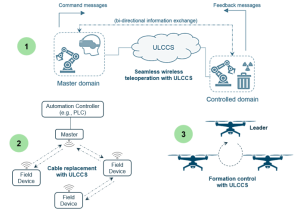
To assess the feasibility of GALLOP in practice, Toshiba’s Bristol lab conducted a series of targeted proof-of-concept implementations and technology demonstrations at international venues like IEEE INFOCOM and ACM EWSN, including:
• Wireless control of autonomous guided vehicles (AGVs) in dynamic environments
• Remote balancing of an inverted pendulum on wheels, showcasing ultra-fast closed-loop stability over wireless links
• Untethered haptic teleoperation for industrial applications like nuclear decommissioning, where GALLOP exhibited wire-like performance.
• Real-time wireless control of large-scale battery systems, evaluating performance under demanding industrial control conditions representative of operational conditions in energy storage management systems.
These experiments confirmed that GALLOP and the broader ULCCS framework can deliver the timing precision, reliability, and predictability needed for stable feedback control across multiple industrial use-cases.
[1] International Electrotechnical Commission
[2] https://webstore.iec.ch/en/publication/70809
[3] A. Aijaz and A. Stanoev, “Closing the Loop: A High-Performance Connectivity Solution for Realizing Wireless Closed-Loop Control in Industrial IoT Applications,” in IEEE Internet of Things Journal, vol. 8, no. 15, pp. 11860-11876, 1 Aug.1, 2021, doi: 10.1109/JIOT.2021.3073505.
IEC 63448: A Framework for Deterministic Industrial Wireless
With the laboratory work and empirical validation completed, Toshiba initiated the IEC standardization process for ULCCS. Dr. Aijaz served as project leader for IEC 63448, coordinating national committee experts, guiding technical discussions, structuring the document, and leading the consensus process.
IEC 63448 defines a framework for deterministic and ultra-responsive wireless communication used in automation and control environments. The standard specifies:
• A lean control-aware protocol stack,
• Timing mechanisms, and coordinated procedures to guarantee bounded latency and jitter
• Management functions aligned with the needs of closed-loop industrial control, motion control, distributed actuation, and other time-critical applications.
By aligning wireless communication precisely with close-loop control requirements, ULCCS provides a unified reference for organizations designing, evaluating, or deploying wireless systems with stringent timing and responsiveness requirements.
Strengthening Toshiba’s Role in Industrial Digital Transformation
“IEC 63448 underlines BRIL’s role as a global innovation hub for industrial connectivity and control,” said Prof. Mahesh Sooriyabandara, Managing Director, Toshiba’s Bristol Research and Innovation Laboratory. “Our team has taken a concept from early-stage research, through rigorous experimentation in real-world-like environments, all the way to an international IEC standard. This is exactly the type of research-to-standards-to-impact pipeline BRIL is committed to delivering for Toshiba and its partners in manufacturing, energy, and advanced automation.”
Toshiba will continue its engagement in IEC committees and related standardization bodies and will work with industrial and academic partners to explore new use-cases for IEC 63448. In line with Toshiba’s broader digital transformation strategy, the company remains committed to advancing information, communication and control technologies that improve operational efficiency, resilience and safety.
The publication of IEC 63448 provides a clear foundation for next wave of time-critical wireless communication solutions for industrial environments and highlights the role of Toshiba’s Bristol Research and Innovation Laboratory in advancing not only industrial connectivity but also the wider digitalisation of information flows, control systems, and cyber-physical infrastructure.
About Toshiba’s Bristol Research and Innovation Laboratory (BRIL)
Toshiba’s Bristol Research and Innovation Laboratory (BRIL) is a leading European research hub focused on digital and industrial technologies, including advanced communications, AI-enabled control, energy systems, and cyber-physical infrastructures. BRIL works closely with industrial, academic, and public-sector partners to translate foundational research into standards, products, and large-scale demonstrators.
Find out more at Home – Toshiba BRIL.