

Quantum Random Number Generators
- Home
- Quantum Information Group
- Quantum Communications Research
- Quantum Random Number Generators
Random numbers are critical for modelling and simulations in science and engineering and have a central role in all cryptographic protocols.
Currently pseudo random number generators (PRNG) are based on algorithms: starting from an initial input number (the seed), all the other numbers can be obtained by making the computer execute the algorithm sequentially. Although this technology is becoming increasingly less suitable due to the eventual predictability of the outputs, its implementation is extremely low cost making PRNG the current choice in cryptographic protocols.
However, pseudo-randomness can result in an expensive outcome if the technological advancements can decrypt communications, get access to sensitive data and tested scientific theories can give wrong predictions.
Recently, researchers proposed devices that harness certain features of quantum mechanics, such as Heisenberg’s Uncertainty Principle, as a source of randomness. These devices are called quantum random number generators, QRNG’s. Advancements in photonics produced devices able to enforce Heisenberg’s Uncertainty Principle on the photons – individual particles of light -and hence obtain genuine random numbers.
A common weak point of encryption protocols that can be exploited in hacker attacks, is the part of key generation, currently implemented by PRNG.
At Toshiba we work on QRNGs that represent a suitable solution to generate secret keys or private keys with a sufficient amount of entropy at the high speeds necessary for real-world applications. Our research explores devices with fast generation rate, compact design, tested resiliency and unpredictability
We have realised a QRNG based on a gain switched laser diode, developed a model to quantify its quantum phase noise, optimising the device performance and improving its security at the same time. The capacity of these devices for high-speed, stable random number generation was recently demonstrated by their integration into QKD demonstration.

Selected publications

Characterizing Phase Noise in a Gain-Switched Laser Diode for Quantum...
V. Lovic et al., Physical Review Applied
04/11/2021
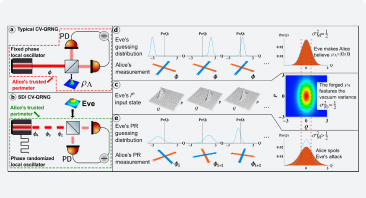
Simple source device-independent continuous-variable quantum random...
P. R. Smith et al., Physical Review A
17/07/2019
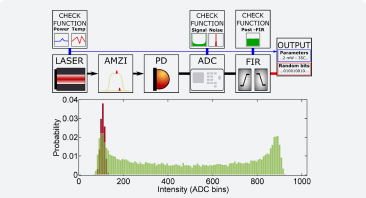
Long term test of a fast and compact Quantum Random Number Generator
D.G. Marangon et al., Journal of Lightwave Technology, no. 17
11/07/2018
Quantum Information Group Latest Publications
Information contained in news and other announcements is current on the date of posting, but subject to change without notice.
A.H. Brzosko, Y. S. Lo, P. R. Smith, R. I. Woodward, D. G. Marangon, J. F. Dynes, S. Juárez, T. K. Paraíso, R. M. Stevenson, and A. J. Shields
S. Juárez, A. Marcomini, M. Petrov, R. I. Woodward, T. J. Dowling, R. M. Stevenson, M. Curty, and D. Rusca
P. Laccotripes, J. Huang, G. Shooter, M. S. Winnel, A. Barbiero, D. A. Ritchie, A. J. Shields, T. Müller, and R. M. Stevenson